
LionShare Joins TILT Story, Creating Combined Business with Expanded Healthcare Marketing Capabilities

Kansas City-based healthcare CRM and marketing automation firm adds data capabilities to TILT Story’s growing platform; President Sara Dykes to continue leading LionShare’s team

Lenexa, KS, September 21, 2026 – TILT Story today announced a merger with LionShare, Inc., a Kansas City-based leader in healthcare CRM and data-driven marketing automation. LionShare will continue operating under its own name and current team, with President Sara Dykes continuing to lead day-to-day operations.

The move expands TILT Story’s capabilities, joining LionShare’s proprietary CRM platform, decades of healthcare-exclusive CRM and a long track record of measurable, ROI-driven client results with TILT Story’s healthcare-focused brand strategy, creative, and content offerings.

As TILT Story listened to clients about what they wanted and built out the strategy to fill those needs, the value of combining traditional agency capabilities with data-driven CRM, marketing automation, and data analytics emerged as a critical focus.

The healthcare marketing industry has a clear gap in matching real, measurable ROI to marketing actions and using that data to drive further growth. LionShare is deeply respected for the rigor of its data, quality of its people, and long track record in the industry, while TILT Story delivers industry leading creative and brand strategy to its clients. In joining forces, both companies see an opportunity to join LionShare’s data focused capabilities with TILT Story’s creative and brand services to better serve clients.

TILT Story and LionShare are committed to jointly investing in new capabilities, including further building out the existing CRM platform, as well as adding new, innovative capabilities for clients.

LionShare founder Laura Lee Jones, an industry pioneer who built the company from the ground up, will transition to Founder & Executive Advisor. As part of the move, she will also join the board.  Sara Dykes, LionShare’s President, will continue to lead the LionShare team and client relationships without interruption.

“After more than 30 years of building this company, I couldn’t be more confident about this decision to merge. With Sara’s steady hand continuing to lead the business, we will stay committed to our culture and growth in the industry.  I’m excited to see what she and this team can accomplish with the added resources and reach of TILT Story. Healthcare marketing has always been a bit of science and art, so this combined team of big brains and big hearts is the right next chapter for LionShare. People have always come first, and our commitment to employees and clients will continue to be our foundation. I’ll remain closely involved, but this next chapter belongs to Sara and the team. I know LionShare and our clients are in excellent hands. I could not be more proud or enthusiastic about the future.” said Laura Lee Jones.

“One of the things we look for as we build this platform is real ROI: proof that the work we do actually moves the business,” said Joanne Thornton, CEO of TILT Story. “LionShare is exceptionally well respected in healthcare CRM and marketing automation, shares a client base with us, and is a strong fit for us both in capability and in culture. This is exactly the kind of partner we set out to find as we build TILT Story.”

Terms of the transaction were not disclosed.

About LionShare

Founded in 1995 and based in Kansas City, LionShare is a healthcare-exclusive CRM and marketing automation firm serving hospitals and health systems nationwide. Its proprietary CRM platform combines data analytics, business intelligence, and automated marketing execution to help healthcare organizations build measurable, ROI-driven relationships with patients, prospective patients, and physicians. Learn more at lionsharemarketing.com.

About TILT Story

TILT Story is the agency that shapes health moments into business momentum. Fueled by unconventional thinking and one relentless belief: health is in every moment, so your brand should be too. By uniting strategic consulting, breakthrough creative, bespoke marketing technologies, and data analytics, TILT Story transforms healthcare marketing into a growth lever. Learn more at tiltstory.com.

Direct Mail Isn’t Dead: Why It Still Delivers in Healthcare Marketing

Every few years, someone predicts the “death” of direct mail. Yet time and again, it proves to be one of the most reliable, ROI-positive channels for healthcare marketers. When done right, direct mail doesn’t just land in the mailbox – it lands results.

Take one health system in the South, for example. Their lapsed primary care campaign has run for three consecutive years, with returns climbing steadily: 4x ROI in 2024, 5x in 2025, and most recently, 7x ROI this spring. That kind of momentum doesn’t happen by accident – it happens when the content is crafted with intention.

And it’s not just primary care seeing the impact. Direct mail also proves its worth in specialty campaigns, where the audience — and the stakes — are often more focused. One health system in the Northeast consistently used direct mail to reach men about urology care and achieved a return of $142 for every $1 they invested in the campaign. For a specialty service line, those results are a clear reminder: the right message, in the right mailbox, drives action.

Whether it’s reconnecting lapsed patients or motivating someone to take that next step in their care journey, direct mail has a way of breaking through. It’s tangible. It’s personal. And when paired with smart data and precise targeting, it’s as modern and effective as any digital channel out there.

Why Direct Mail Continues to Work

A Tangible Connection in a Digital World

Email inboxes are crowded. Digital ads flash and disappear. But a piece of direct mail? It sits on the counter. It gets pinned to the fridge. It’s read more than once. In healthcare, where decisions often involve the whole household, that kind of visibility matters.

Smarter, More Personalized Than Ever

Direct mail today doesn’t look like it did ten years ago. With CRM-driven targeting, we can deliver letters, postcards, and custom pieces tailored to a household’s needs. Whether it’s a heart health screening reminder or a welcome message to new movers, data turns “junk mail” into “just what I needed.”

Driving Real Action

Direct mail isn’t just about awareness — it’s about response. A well-designed piece guides patients to the next step, whether that’s scanning a QR code, visiting a vanity URL, or picking up the phone.

Strongest When Integrated

Here’s the secret: direct mail works best as part of a bigger strategy. Pair it with email, paid digital, or retargeting, and you create multiple touchpoints that reinforce each other. When a message shows up in the mailbox and the inbox, the impact multiplies.

Bottom Line

Direct mail isn’t old school — it’s proven. In a world where patients are overwhelmed by digital noise, a tangible, personalized piece of communication stands out. For healthcare marketers, it remains one of the smartest, most measurable ways to connect and drive results.

30 Years of Best Practices for Smarter Healthcare Marketing

At LionShare, we’ve spent three decades creating and optimizing healthcare campaigns for organizations across the country. In that time, we’ve learned this: the best campaigns don’t just get seen, they get remembered, acted on, and measured.

In 2025 that takes more than just ‘getting it out there.’ It’s about reaching the right people with the right message at the right time, backed by the smart use of data, compelling creative, and consistent follow-through.

Here’s our field-tested guide to making your marketing work harder (and smarter).

1. Craft CTAs That Actually Get Clicked

A call-to-action (CTA) is more than just a button — it’s your bridge from interest to engagement, so make it count.

  • Use color and placement strategically so CTAs stand out when scanning.
  • Lead with strong action words (“Book my appointment,” “Lower my risk”) and add first-person language to spark ownership and urgency.
  • Consider secondary CTAs like health risk assessments to drive additional engagement.

CRM tip: Test multiple CTA variations and placements, then let the performance data guide your next move.

2. Write Content Patients Actually Want to Read

If your content sounds like it belongs in a boardroom instead of a busy parent’s inbox, it’s time to rethink.

  • Skip the acronyms and aim for a 6th-grade reading level to reach the widest audience.
  • Lead with benefits or problem-solving, not corporate jargon.
  • Add personal touches, like first name, to make the message feel more human.

CRM tip: Time communications to align with life stages or engagement activity, ensuring the message feels relevant without revealing personal health details.

3. Don’t Sleep on Direct Mail

In a digital-first world, a well-designed mailer can still grab attention and drive action.

  • Personalize letters for higher engagement.
  • Use QR codes and vanity URLs for easy tracking.
  • Keep copy short and scannable, with a crystal-clear next step.

CRM tip: Use propensity data to find your best prospects to maximize every dollar.

4. Make Digital Work Harder for You

Clicks and impressions are nice, but patient encounters are the real goal.

  • Use UTM codes to track campaign impact well beyond the click.
  • Create custom landing pages so every campaign has a clear, relevant destination.
  • Compare results across owned and paid channels to see what’s truly driving action.

CRM tip: Once you have a digital conversion, continue the conversation with automated email journeys.

5. Get More from Email

Email isn’t dead, but bad email is.

  • Keep headers 600 pixels wide and add ALT text to every image.
  • Design for skimmers who give you no more than 7 seconds of their attention.
  • Test every element — subject lines, send times, graphics, personalization.
  • Send “echo emails” to non-openers to give your message a second chance.

CRM tip: Automate strategic email campaigns to keep your pipeline full without extra lift.

6. Find Your Frequency Sweet Spot

Patients rarely act the first time they hear from you.

  • Use consistent, multi-channel communication to build trust.
  • Monthly is a safe cadence for broad-topic messages and newsletters.
  • Balance ongoing engagement with timely, single-top campaigns for stronger response.

CRM tip: Use engagement trends to identify when interest starts to dip or peak, then adjust timing accordingly.

Bottom Line

For 30 years we’ve proven that the healthcare marketers who succeed are the ones who put the patient first and let the data lead the way. When you pair clear calls-to-action, relevant content, and a CRM-powered strategy, every campaign becomes more than just marketing. It becomes a measurable driver of trust, engagement, and long-term growth.

Create Once, Convert Often: First-Party Campaigns That Keep Delivering

In today’s privacy-first world, health systems can no longer rely on third-party data to drive engagement. The key to smarter, more sustainable marketing? First-party data — and a CRM that puts it to work. That’s exactly what one West Coast health system did in partnership with LionShare. The goal: capture consumer preferences and use them to fuel a more personalized, higher-performing communication  strategy.

From Sign-Up Page to Smart Engagement

Together, we built a custom sign-up page where consumers could opt in to receive emails on health topics that mattered most to them — from heart health and women’s wellness to orthopedics and cancer prevention.

But this wasn’t a generic newsletter list. Each new subscriber triggered a dynamic CRM workflow tailored to their selections. Subscribers receive monthly emails with content specific to their chosen topics, creating a sense of relevance and trust from the very first touchpoint.

The Results? Big.

  • 34%+ Average Open Rates – When emails reflect personal interest, people pay attention.
  • 21% Utilization Rate – These weren’t just clicks. They were people showing up for care.
  • Exceptionally High ROI – With minimal investment, this campaign delivered measurable growth in service line revenue, proving that the right data + the right message = real impact.

What Made It Work

This campaign succeeded not because it did more, but because it did what mattered. We didn’t blast every message to every person. We listened first, then delivered curated content to the right audience at the right time.

By aligning CRM strategy with first-party data collection, this health system was able to:

  • Build a high-quality, self-selected audience
  • Nurture trust through consistent, relevant content
  • Drive measurable clinical activity tied directly to marketing efforts

Why It Matters

In a world where engagement is harder to earn — and data is harder to come by — strategies like this are a game changer. They prove that even a simple sign-up page can lead to serious ROI when paired with a smart CRM engine and a clear content strategy.

A Landing Page That Does More Than Capture Clicks

Another health system took this idea even further. As part of its new brand campaign , LionShare helped build a custom landing page designed to empower community members with trusted, engaging content — and gently guide them toward primary care.

After filling out a short form, users could:

  • Download a Guide to Better Health
  • Explore a curated hub of health content
  • Receive a nurture email series with top wellness tips

But the page didn’t stop there. The client later used the same landing page to drive a community contest, giving the campaign a second life and proving just how valuable a well-built CRM landing experience can be. Once the foundation was in place, the page became a flexible tool for ongoing first-party data capture and engagement.

The Big Picture

What both campaigns have in common — and what more health systems are realizing every day — is that first-party data isn’t just a checkbox. It’s a competitive advantage. When used strategically, even a simple landing page can evolve into a personalization engine, content hub, and conversion tool — all backed by measurable ROI.

With LionShare, you don’t just get creative and campaign support. You get the CRM strategy behind it, too — the kind that turns interest into action, and prospects into patients.

Want to build something that works now and scales later? We’d love to help.

Beyond the Mailbox: What We’ve Learned from 30 Years of New Mover Programs

Some things never change: people will always move. A new job, a growing family, a fresh start — no matter the reason, relocation brings a flurry of decisions. Where to shop. Where the kids will go to school. And, most importantly, where to go for care. That makes new movers a high-value audience and a powerful opportunity to make a first impression that lasts.

What has changed? The way we reach them.

At LionShare, we’ve been helping hospitals and health systems connect with new movers since day one back in 1995. We’ve launched and analyzed hundreds of programs across diverse markets. And while tactics have evolved, one thing has stayed true: the most successful New Mover Programs aren’t just about sending a mailer. They’re about building smart, measurable journeys that make it easy for someone to say, “Yes, I trust this place with my care.”

What Sets Winning New Mover Campaigns Apart?

We’ve honed best practices that consistently drive utilization, ROI, and client satisfaction. The secret? A mix of strategy, technology, and testing — lots of testing. Here’s what makes the difference:

1. Integrated Journeys

We go beyond the mailbox. Yes, the direct mail piece still matters (especially when it’s timely and well-designed). But we pair it with email outreach, PPC, social ads, and retargeting, all built around the consumer’s behavior. It’s about showing up in the right places, at the right time.

2. Personalization that Performs

Today’s consumers expect relevance. We make it easy to say “yes” by including the new mover’s name, identifying the closest care location, and even embedding a personalized map or directions. It’s a small touch with a big impact that helps earn trust fast.

3. Relationship Nurturing

The first outreach is just the beginning. Once someone engages, we help you capture their preferences and communication opt-ins to continue the conversation in a way that feels personal, not pushy.

4. Relentless Testing

We live and breathe data, which means we never stop learning. We test everything — offers, creative, subject lines, audience segments — and optimize based on performance. It’s how we keep programs improving, not just running.

5. Dashboard Reporting

What’s better than a great New Mover Program? A clear dashboard that shows exactly how it’s performing. From short-term KPIs like clicks and form fills to long-term results like utilization and ROI; we measure what matters.

Because what good is a great strategy if you can’t prove it worked?

The Mail Piece Gets You to the Door. We Help You Get Invited In.

A well-run New Mover Program can be the start of a lifelong relationship — but only if it’s built with intention. At LionShare, we don’t just send mail. We create coordinated, data-driven journeys that connect across channels and drive measurable results.

Whether it’s a New Mover Program or a full-scale CRM, we go beyond the basics in everything we do. With decades of healthcare experience and a relentless focus on ROI, we help you reach the right audience, at the right time, in the ways that matter most.

Need help getting your foot in the door? Let’s talk.

10 Smart Moves When Exploring CRM for Your Organization

When it comes to customer relationship management (CRM), some healthcare systems are just getting started, while others are well into their journey. No matter where you start, one key factor consistently sets successful CRM programs apart: planning.

In a world of shifting priorities, siloed data, and ever-evolving technology, strong preparation is what separates success from setback. Before you choose a partner or build your roadmap, consider these ten smart moves to set your CRM strategy up for long-term impact.

1. Align CRM with Organizational Goals

What are you trying to achieve? Maybe it’s capturing market share, increasing service line volume, improving retention — or all of the above. Define your strategic priorities upfront and they’ll serve as the foundation for every CRM decision that follows.

2. Identify Internal Champions

CRM success isn’t just Marketing’s job. It requires buy-in across departments. Engage IT, finance, legal, and compliance early. These internal champions can help navigate approvals, secure resources, and maintain momentum long after launch.

3. Understand the Implementation Timeline

No two implementations look the same. Ask potential partners to walk you through their onboarding process, including timing, milestones, and common hurdles. A realistic timeline builds internal alignment and sets everyone up for success.

4. Prioritize Scalability

Healthcare is changing fast, and your CRM should keep pace. Look for a flexible, future-ready platform that can grow with your team and adapt as your needs evolve. Scalability ensures today’s solution still works tomorrow.

5. Ensure a Unified, Compliant View of Your Data

CRM should give you a single, integrated view of your consumers across email, direct mail, health risk assessments, and more. Just as important, it must handle suppression management and preference tracking in a way that keeps you compliant with state and federal privacy laws. Look for a CRM that can centralize this view, integrate with other platforms, and keep your organization legally sound.

6. Be Realistic About Internal Resources

CRM success takes more than pulling a list and hitting “send.” It demands time, strategy, and expertise in data management, automation, segmentation, and analytics. Many teams find they don’t have the internal bandwidth to maintain momentum alone. Start by evaluating your capacity, then consider where a strategic partner can fill the gaps with smart guidance and day-to-day lift.

7. Choose a Partner with Healthcare (and Marketing) Expertise

CRM isn’t one-size-fits-all, especially in healthcare. A strong track record in the industry matters, particularly when it comes to understanding how CRM fits within your broader tech ecosystem. From call center databases to foundation donor systems to EMR-based tools for clinical reminders, many departments operate their own version of “CRM.”

Each plays a valuable role. But a marketing CRM serves a distinct purpose: reaching beyond your existing patient base, integrating data from multiple sources, and guiding personalized outreach to both prospects and patients. It doesn’t compete with your existing systems — it complements them. The right partner will know how to align with what’s already in place, while filling the gaps those systems weren’t built to address. That takes real experience navigating healthcare data—and a deep understanding of marketing strategy.

8. Measure What Matters

Impressions, opens, and clicks can show early engagement, but leadership needs more. To secure long-term support, you’ll need to connect marketing activity to meaningful outcomes like patient volume, retention, and revenue. A strong CRM platform should help you track those results directly. Even more importantly, it should give you visibility into ROI across all marketing channels, not just those deployed within the CRM. That means integrating with other tools and data sources, so you can understand how each effort contributes to growth. When CRM is tied to strategic goals and broader performance metrics, it becomes a tool for true organizational impact.

9. Think Beyond Marketing

CRM may live in Marketing, but its value stretches far beyond. A strong platform can uncover insights that drive decisions across the organization, such as trends in readmissions, value vs. volume analysis, or how digital engagement correlates to in-person care. With the right data strategy, CRM becomes an engine for smarter decision-making across the board.

10. Start Smart, Then Scale

CRM doesn’t have to start big to make a big impact. Begin with targeted campaigns that align to high-value goals and deliver measurable wins. Once your leadership team sees proven ROI, it becomes easier to expand your investment over time. Smart CRM programs can be built in phases, scaling thoughtfully as data, results, and confidence build.

Set the Stage for CRM Success

Every CRM journey is different, but success always starts with strategy. A thoughtful plan on the front end sets the stage for smoother execution, faster wins, and long-term impact. The right CRM partner won’t just implement a system, they’ll work alongside you, offering strategic insight, anticipating needs, and helping your team achieve meaningful results every step of the way.

At LionShare, we’ve spent 30 years helping healthcare marketers plan, grow, and optimize CRM strategies that deliver real results.

Let’s talk about what’s next.

3 High-Impact CRM Campaigns to Jumpstart Your Marketing Success 

In healthcare marketing, finding quick wins can often feel like searching for a needle in a haystack. But when it comes to CRM trigger campaigns, the opportunity to create meaningful impact is well within reach. Whether you’re looking to kickstart a new CRM program, reignite existing efforts, or make the case for a full-scale CRM implementation, these easy-to-launch campaigns deliver big results—fast.

Here are three high-impact campaigns designed to maximize your patient data, engage your audience, and drive measurable results:

1. Re-Engaging Lapsed Patients

One of the most cost-effective ways to drive volume and reconnect with your audience is by targeting lapsed patients. By using your CRM to identify patients who haven’t returned to your system within a specific timeframe, you can send personalized outreach that invites them back.

For example, remind them of the importance of regular check-ups or follow up on previously recommended care. Sweeten the deal by offering scheduling incentives or highlighting new providers or locations for added convenience.

Why it works: These campaigns tap into an audience already familiar with your brand, making them more likely to re-engage. Plus, they’re a proven way to boost primary care or specialty clinic volumes.

2. Attracting New Movers

Stealing market share can be tough, but welcoming new residents to your market is much easier. A new mover campaign is an effective strategy to reach patient acquisition goals by introducing your healthcare system to households seeking services near their new home. By identifying new movers into your market, you can deploy a multi-touch strategy that includes direct mail, email, and digital campaigns. Bonus: These campaigns can also capture existing patients who have relocated within your service area, helping them discover nearby services and providers.

Why it works: New movers are actively searching for doctors and healthcare services. By positioning your organization as the trusted, convenient choice, you’ll stay top of mind when they’re ready to book their first appointment.

3. Preventive Care Awareness Campaigns

Preventive care campaigns are key to encouraging patients to prioritize their health while also maintaining steady patient volumes throughout your system.

Use your CRM to identify patients overdue for critical screenings like mammograms or colonoscopies, or vaccinations like flu shots. Another effective approach is using online Health Risk Assessments (HRAs). These interactive quizzes empower patients to evaluate their risks and guide them toward appropriate next steps, such as scheduling an appointment. Pair the HRA with a multi-touch email nurture series for ongoing engagement.

Why it works: These campaigns motivate patients to take proactive steps toward better health while keeping your organization top-of-mind as a trusted partner in their care.

Keep Feeding the Funnel

These three campaigns are just the beginning. Starting small and tracking results allows you to build a strong case for deeper CRM investments and eventually expand into more sophisticated strategies.

If you’re ready to take the next step or need inspiration to kick off your next campaign, the LionShare team is here to help. With smart solutions tailored to your unique challenges, we’ll help you maximize your CRM and achieve measurable marketing success. Let’s strategize together to make the most of your CRM and achieve your marketing goals.

The Math That Matters: Measuring ROI with Control Groups

Spoiler Alert: There Will Be Math

If you’re a healthcare marketer looking to prove the ROI of your campaigns, we’ve got good news and bad news. The bad news? ROI calculations involve some math (sorry about that). The good news? The right math gives you undeniable proof of your marketing impact—and that’s worth every equation.

At LionShare, we’re big fans of breaking things down to what really matters. That’s why we’re diving into how control groups—and yes, some simple math—can transform your marketing strategy from “pretty good” to “provably effective.”

Why Math (and Control Groups) Matter

When your CFO asks, “Wouldn’t those patients have come in anyway?” you need more than a shrug or a hunch. You need data that tells the story. That’s where control groups come in.

Control groups are the unsung heroes of marketing measurement. By comparing those who received your campaign to those who didn’t, you get a crystal-clear view of your campaign’s true impact. Think of it as finding the difference between what would have happened naturally and what your campaign achieved.

The Steps (and Math) Behind ROI

Here’s how you calculate ROI like a pro:

  1. Define your groups
    Select your campaign group and your control group. Typically, your control group will be about 10% of the size of your campaign group.
  2. Track performance
    Over a set period (say, a year), measure the downstream revenue generated by both groups.
  3. Equalize the control group
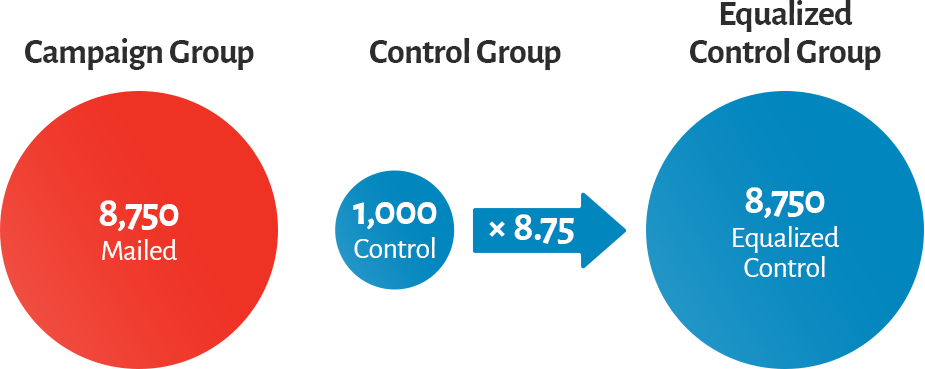
    Since the Campaign group and the Control group are not equal in size, to properly compare, it’s important to look at what the outcome would be if the control group was assumed to be the same size as the mailed quantity in the campaign group.

    For example, if your campaign group is 8,750 households and your control group is 1,000, to find the multiplier needed, divide the Mailed quantity by the Control quantity (8,750/1,000) to get 8.75.

    The multiplier is used to determine the expected results of the Control group revenue.

  4. Calculate the lift in revenue
    Subtract the equalized control group revenue from the campaign group revenue. This tells you how much additional revenue your campaign generated.
  5. Plug into the ROI formula
    Use this equation:

    ROI =
    Lift in Revenue − Campaign Cost
    Campaign Cost
    × 100
  6. Interpret the ROI
    ROI percentages can feel abstract, so translate them into something relatable. For example, an ROI of 165% means for every $1 spent, your campaign brought in $1.65.

ROI in Action

To help show how to apply these formulas, we’ll walk through a hypothetical campaign using the equalization numbers we calculated above. Let’s say these are for a campaign for primary care services with the following results:

  • Campaign Group Revenue: $85,000
  • Control Group Revenue: $6,150
  • Campaign Cost: $10,000

Here’s how we get to the ROI staring with step 3:

  1. Equalize the control group:
    Using the numbers from above, we can then apply the equalization factor of 8.75 to the control group revenue:

    $6,150 x 8.75 = $53,812.50

  2. Calculate the lift in revenue:
    We get the Lift in Revenue by subtracting the equalized control group revenue from the campaign group revenue

    $85,000 − $53,812.50 = $33,187.50

  3. Calculate the ROI:
    Using the ROI formula on our numbers get us the following:

    ROI (%) =
    85,000 − 33,187.50
    10,000
    × 100 = 518.13%
  4. Interpret the ROI:
    A 518.13% ROI means your campaign generated $5.18 for every dollar spent.

Why the Math is Worth It

Sure, math might not be the most exciting part of marketing, but it’s essential for proving your value. Without it, you’re relying on guesswork. With it, you’re showing leadership how your marketing dollars drive measurable results.

And if you ever need help crunching the numbers (or convincing your CFO), LionShare is here. We bring the math, the strategy, and the smarts to make your marketing work harder—and prove it.

Give us a call. We promise, there won’t be a test.

Accessible Email Best Practices for Healthcare Marketers

Accessibility has always been an important part of effective digital communication. With the U.S. Department of Health and Human Services (HHS) Office for Civil Rights (OCR) recently extending by one-year the compliance deadlines for accessibility standards under Section 504 of the Rehabilitation Act of 1973, many healthcare organizations are taking a closer look at how their websites, emails, and digital campaigns support accessible user experiences. While the updated timeline provides additional flexibility, it also reinforces the growing importance of building accessibility into digital communication strategies from the start.

The good news is that many of the current recommendations align closely with standards and best practices that experienced teams have followed for years, including guidance from WCAG, WebAIM, and the broader email development community.

For many organizations, accessibility improvements are less about reinventing processes and more about strengthening the standards already built into thoughtful marketing execution.

At LionShare, accessibility considerations have long been part of how we approach email campaigns and landing page development. From readable typography and mobile-friendly layouts to thoughtful link structure and content hierarchy, accessibility supports the larger goal of creating clear, usable experiences for every audience.

Here are five best practices healthcare marketers should prioritize when building accessible email campaigns.

1. Begin at the Beginning

One of the most immediate and impactful improvements organizations can make is providing alt text for campaign-specific images. This copy is required by ADA to be included on any meaningful visual content, and all too often it is left until the end for development to add in.

The writers and marketers developing campaign messaging are better positioned to provide this meaningful text because they understand the image’s role within the broader communication.

Good alt text is not simply a literal description of an image. It should communicate the purpose, context, or function of the image when relevant to the user experience.

Just as important, not every image requires detailed alt text. Decorative images may add little informational value, while instructional or contextual imagery often plays a more important role.

Incorporating alt text into campaign deliverables from the beginning creates a more consistent process and helps ensure accessibility remains part of the overall communication strategy, not just a technical afterthought.

2. Say What You Mean

Accessibility improvements often lead to stronger communication overall. One common example is when you replace vague calls to action like ‘Click Here’ with more descriptive language that clearly explains where the user is going after the click.

Examples of more accessible CTAs that can also lead to better click-through are:

  • View Cardiology Services
  • Download the Screening Guide
  • Schedule an Appointment

Descriptive links create a better experience for screen reader users while also improving usability and engagement for all audiences.

3. Make it Look Good

Your emails should be easy to read regardless of device, screen size, or visual ability. Several simple design choices can significantly improve readability, including:

  • Readable font sizes
  • Strong color contrast
  • Clear content hierarchy
  • Adequate spacing between text elements
  • Mobile-friendly buttons and layouts

These practices not only support accessibility but also create a more intuitive experience for increasingly mobile – and easily distracted – audiences.

4. Make it Make Sense

While current ADA regulations do not require plain text versions of emails, your audience still may not get your image. From user managed settings to the functionality of assistive tools, there will always be a portion of your audience who won’t see your graphics.

Accessible email development plans for this situation by using live text, meaningful alt text, and thoughtful content structure to ensure campaigns remain understandable across the board, even without imagery.

5. Keep the Party Going

Accessibility is not a one and done initiative. Like all effective digital communication practices, it continues to evolve alongside technology, user expectations, and industry standards. By including it as part of every new campaign, you’ll be prepared when standards inevitably evolve and new best practices emerge.

Bottom Line

With these 5 best practices in your pocket, you are set to improve the clarity, usability, and overall patient experience of your digital communications. And in healthcare marketing, better experiences lead to better engagement.

Transforming CRM Resources into Business Intelligence: 3 Case Studies

Today’s healthcare landscape requires looking at business intelligence from a different perspective, and perhaps getting that intelligence from a different source. Traditional CRMs are often nothing more than repositories of customer information that are used solely for list development and campaign execution. However, there are more advanced CRM systems that can do more than just hold data – they can help you make better business decisions.

It all starts with the data you feed into your CRM. If you’re able to integrate clinical and financial data, online and call center activity, channel preferences, and healthcare propensities, you can start viewing how that information interacts. That data then becomes your single source of truth for all patients, market prospects, physicians, and employees (along with any other data you desire), and can then help drive your business decisions.

What’s next is the ability to link analytics to execution. You could examine analytical insights related to value versus volume, patient footpaths/continuums of care, readmission levels, population health, physician leakage, engagements versus encounters, and so much more. Here are three real-world examples from some of our clients:

Opioid Study

  • Question: What is the breakout of intentional vs. unintentional opiate overdoses, and are there any co-occurring psych DX?
  • Findings: 43% of overdoses were admitted to ED (unintentional), 20% into Psych (intentional). There were no co-occurring DX, and income and geography had no effect.
  • Conclusion: In addition to answering the initial question, it was also found that prescriptions coming from doctors in the hospital system did not increase the propensity of opioid overdoses.

Wellness Program

  • Question: Would a monitored exercise program for former inpatients reduce their readmission rates?
  • Findings: While those in the exercise program did not see reduced readmission rates, readmits were less costly among participants vs all other hospital admissions. The most dramatic difference occurred in those participants with higher program attendance rates (showed up to half or more of the meetings).
  • Conclusion: While the number of readmits didn’t change much, the cost per patient savings of around $6k could be used as a personal reason to encourage people to participate in the program.

Competitive Study

  • Question: What is the potential risk to the system of a new ER located near us, and how many individuals are closer to that new facility than us?
  • Findings: While the new ER was closer to some patients, proximity proved to be less of a factor than travel time. The current location was still the quickest to reach due to better highway access.
  • Conclusion: Since less than 5% of the local market would be affected, no major adjustments needed to be made.

Armed with better information, strategists and c-level executives can plan short and long-term growth strategies with more confidence than before.

Regardless of the challenge – whether it is strategy, financial, or marketing, the right CRM can help uncover what is happening inside the data and provide guidance that allows the data to lead you to the next step.

If you’re looking for a CRM that can provide this kind of business intelligence, contact us at LionShare to learn more about DIATA.